


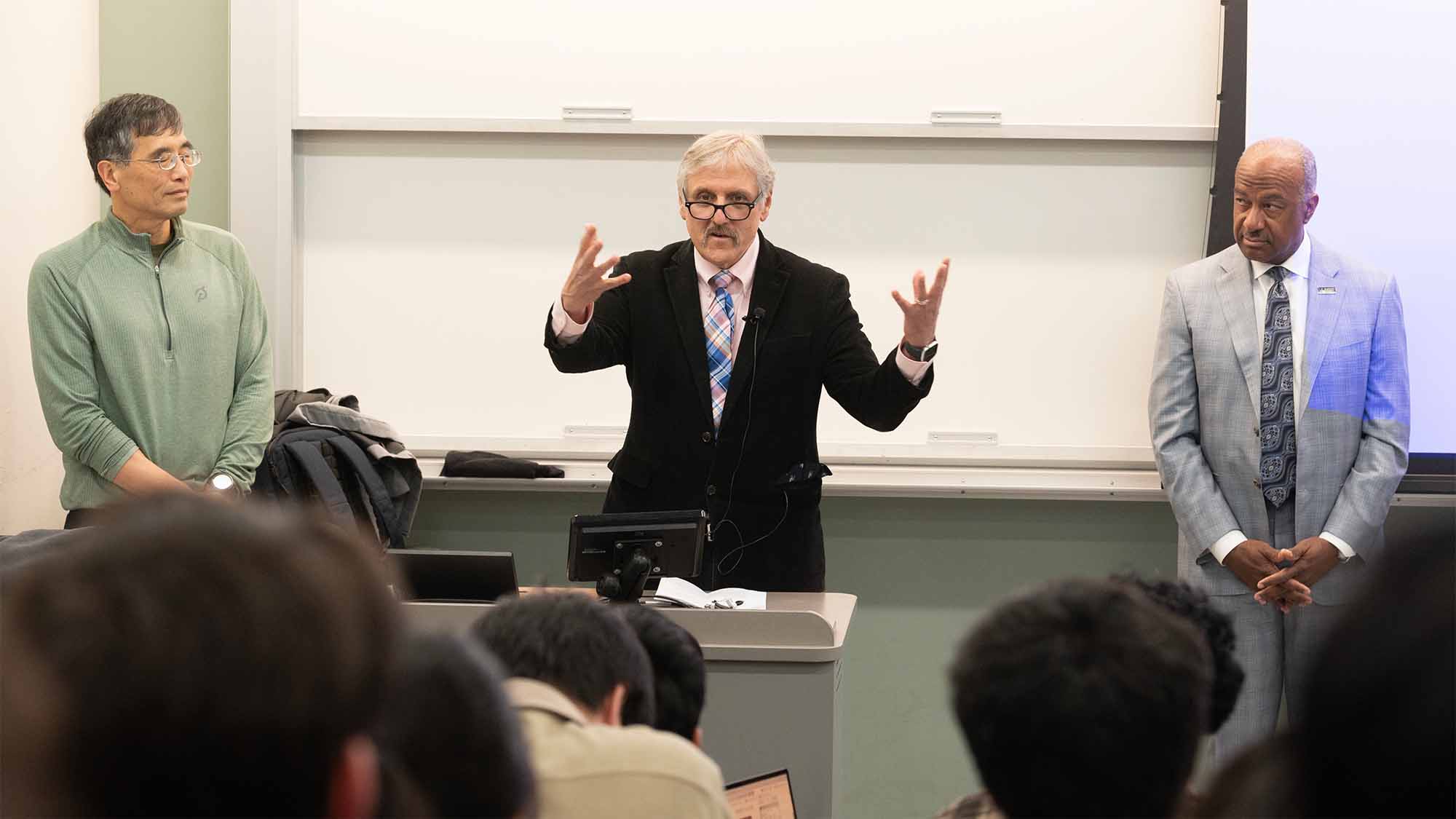
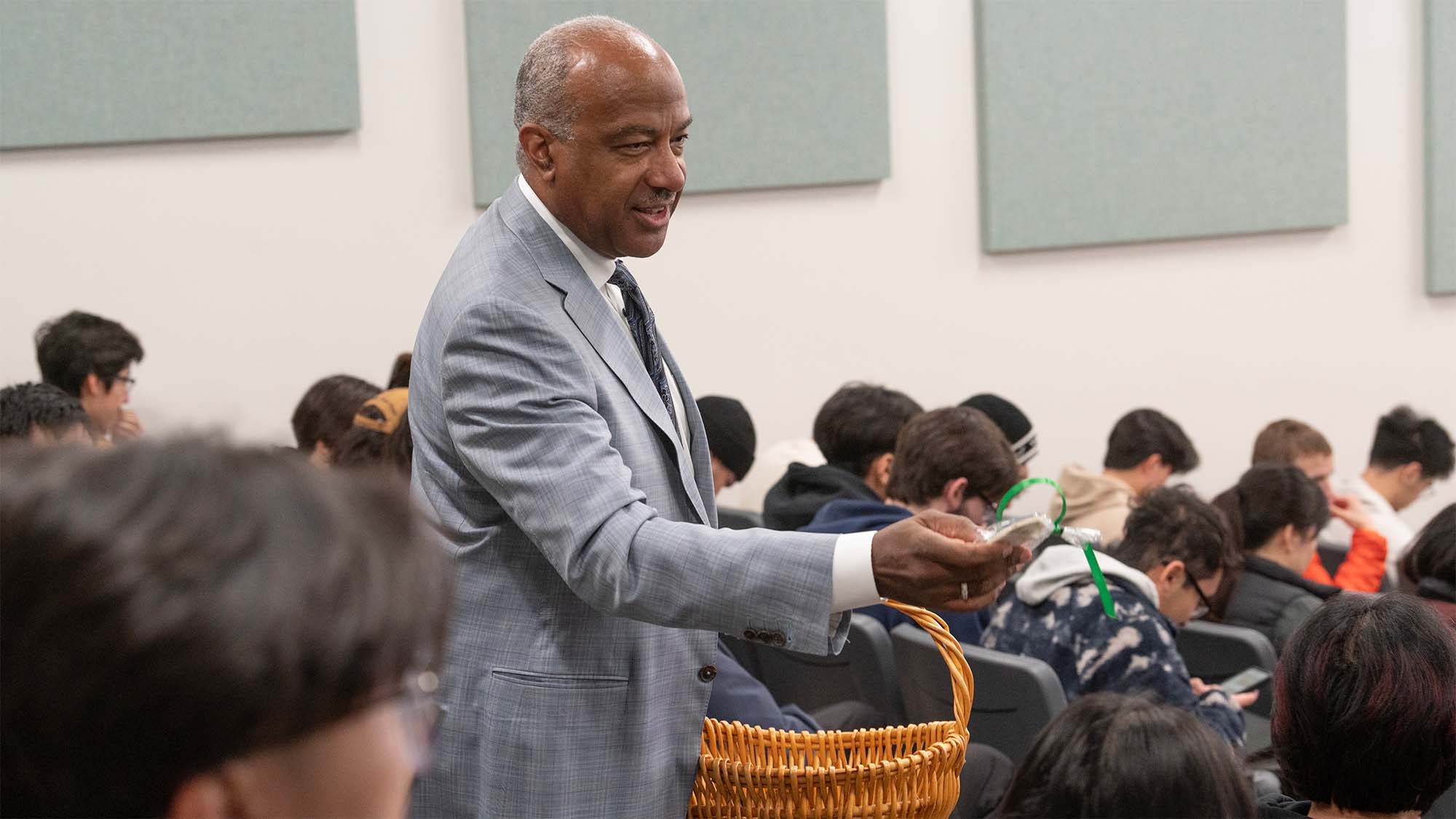
On Monday, Dec. 1, Distinguished Professor of Electrical and Computer Engineering Zhi Ding entered Wellman Hall like any other day, navigating to a near-capacity classroom on the bottom floor to begin his “Signal Analysis and Communications” lecture at the University of California, Davis. As he started teaching, however, he and his students were interrupted by a group of special guests led by Chancellor Gary S. May.
May had come to Ding’s lecture with a special announcement. Following more than 20 years at the university as a scholar and educator advancing the field of wireless communications, Ding had won the 2025-26 UC Davis Prize for Undergraduate Teaching and Scholarly Achievement. The donor-funded $80,000 prize, established in 1986 and supported by the UC Davis Foundation, is among the largest of its kind in the country.
“This award is one of the highest honors the university bestows,” said May, standing before a classroom full of students. “It recognizes extraordinary teaching, scholarly distinction and mentorship that helps students during college and into their careers. Professor Ding is a shining example of all this and more.”
Richard L. Corsi, the dean of the College of Engineering and a member of the group of special guests, echoed May’s sentiment when he took the floor to celebrate Ding, who, since joining UC Davis in 2000, has seamlessly integrated his field-defining research with high-impact teaching, making complex subjects, such as signal processing, clear and understandable for his students and students across the globe.
“The mission of the College of Engineering is ‘creating a sustainable world through socially responsible engineering, inspiring education and transformative research,’” he said. “Professor Ding is the embodiment of that mission statement. He is what we strive to be.”
A signal effort
Since Ding received his Ph.D. in electrical engineering from Cornell University in 1990, wireless communications have undergone significant advancements, from the rise of cell phones to the development of high-speed and artificial intelligence-enabling 5G technologies. Throughout these evolutions, Ding has driven innovation through groundbreaking research in many areas of wireless communication.
One of his earliest contributions was in shaping Multiple-Input Multiple-Output, or MIMO, systems, a communication technique whereby numerous antennas are used as transmitters and receivers to improve information capacity and transmission reliability. This work, along with his advancement of spatial multiplexing methods, has had a significant impact on the development of 4G and 5G technologies.
Adaptive signal processing and equalization are the areas where he has made the greatest impact. He has established the benchmark for nonlinear decision feedback equalizers and reduced-rank adaptive filtering — advancements that have led to improved performance and energy efficiency, enabling development of modern wireless systems.
Recently, Ding has turned his attention to the promise of artificial intelligence, integrating it with his theoretical insight to take wireless communication to the next level.
An industry standard
Ding co-authored Modern Digital and Analog Communication Systems with B.P. Lathi, his across-the-causeway colleague at California State University, Sacramento.
Now in its fifth edition, the book is among the world’s most widely adopted undergraduate textbooks in any discipline. It is used in more than 170 universities worldwide, including in Canada, Australia, India, South Africa, South Korea, Taiwan and the United Kingdom, according to its publisher, Oxford University Press.
“This textbook is the most current at the undergraduate and intermediate levels, providing a solid foundation in telecommunication engineering and connecting foundational concepts with 21st-century communication technologies,” wrote Saif Islam, the chair of the Department of Electrical and Computer Engineering, in his nomination letter for Ding.
Finding the right message
For every class, Ding introduces himself to students not as a professor but as a coach.
This is an important distinction for him, as the students are likewise transformed into a team that must work and learn together. It’s also an opportunity for him to be more approachable to students, blurring the line between mentor and professor, and to “teach” them that school doesn’t have to be a solitary struggle, but a collaborative effort where everyone strives to be better.
Each year during course evaluations, he consistently receives top marks from students. Many say that Coach Ding not only changed the course of their academic career but also fundamentally changed and improved their approach to life.
“Professor Ding fully embodied the coaching role,” wrote a former student in support of him receiving the UC Davis Teaching Prize. “He was consistently available for questions, approachable and invested in our progress. The toolset that I developed in [his] class was not just for signal processing but also for how to tackle hard problems.”
Adaptive education
A hallmark of Ding’s approach to education is his ability to remain nimble in the face of an ever-changing technological landscape, often adopting cutting-edge research into his courses to ensure that his students are appropriately equipped.
An example is his integration of software-defined radio platforms, a relatively new technology. He redesigned “Statistical and Digital Communication,” a course originally intended to provide a theoretical framework for communications concepts, to offer students hands-on learning opportunities with the emergent technology.
Ding designed a set of hands-on experiments for "Signal Analysis and Communications” shortly after joining UC Davis, setting a standard for providing practical learning opportunities for students of wireless communications. He also introduced "Digital Signals and Systems,” an innovative course that prepares engineering students to work on AI and machine learning projects. The computer-centric curriculum uses Python, a programming language underpinning many AI technologies, to introduce students to Discrete Fourier transform and convolutional signal processing, bringing the college’s signal and systems curricula to the cutting edge in 2020.
Ding created "Signal Analysis and Communications” shortly after joining UC Davis, setting a standard for providing practical learning opportunities for students of wireless communication, as well as “Digital Signal Processing,” bringing the college’s wireless communication curriculum to the cutting edge in 2007.
Beyond UC Davis, Ding has also helped kickstart BE-STARSE, an immersive STEM education program funded with nearly $1 million from the National Science Foundation to support K-12 students and teachers in the Sacramento Valley.
Transmission source
When Ding resumed his place at the front of the classroom to share his thoughts on receiving the UC Davis Teaching Prize, he pointed to an important duality in academic life.
“Receiving this award is a tremendous honor because it celebrates two interdependent pillars of academic life that I hold dearest: the dedicated pursuit of scholarly knowledge and the sacred responsibility of translating that knowledge to be accessible and transformative for our students.”
From there, he immediately expressed gratitude to his students.
“Your curiosity, your drive to be successful, your challenging questions and your sheer enthusiasm in the classroom fuel my endeavor every single day,” Ding said. “As I often remind my students and myself, we are on the same team. Being an educator is like being a coach, [because] our students’ success is my ultimate success.”
Throughout his career, Ding has effortlessly woven these sides of a scholar together, from the vanguard researcher pushing science forward to the conversational coach motivating students (and himself) to reach for the best. An enterprise he has never wavered from, continuing to push the frontiers of teaching and scholarship forward for over 30 years and still going strong.
“As a fellow engineer and educator, I’m genuinely inspired by the effect Distinguished Professor Ding has had on our students and our campus. His work reflects the heart of what teaching in our discipline can be,” May said.
Ding, the 39th winner of the UC Davis Prize for Undergraduate Teaching and Scholarly Achievement, will be honored at a gala at the Mondavi Center for the Performing Arts on Feb. 19, 2026. Previous winners are listed on the UC Davis Academic Affairs website.
Media Resources
Media Contacts
- Andy Fell, News and Media Relations, 530-304-8888, ahfell@ucdavis.edu
- Matt Marcure, College of Engineering, mmarcure@ucdavis.edu