


UC Davis fourth-year neurobiology, physiology and behavior major Rogelio Castillo did not expect undergraduate research to open a path for him to create change in his community. His family’s past experiences with rushed and impersonal medical care led him to turn to science to ask the questions that improve both health outcomes and quality of patient-provider relationships.
Castillo currently investigates whether commonly prescribed blood pressure medications, such as Losartan, increase the risk of musculoskeletal injuries. Hypertension — also known as high blood pressure — affects Latinx communities at higher rates, like in Castillo’s farmworker hometown of Lindsay, California. Physically demanding labor in these communities already place significant strain on muscles and joints. When these injuries worsen, they threaten long-term health and livelihoods.
“I wanted to help people from communities like mine who deal with debilitating injuries from constant repetitive labor, like picking grapes or oranges,” Castillo said. “If my research helps people understand more about the medications they rely on, then it provides them with the information they need to advocate for their own health.”
Curiosity in action
UC Davis is classified as an R1 research university, which marks schools with the highest level of research activity. This distinction reflects the scale and impact of discovery across campus — and undergraduates play an active role in it.
"Research allows me to combine my interests in medicine and science. It opened doors I never expected, shown me how lab work connects to real-world impact and helps me share science with my community across languages."
— Rogelio Castillo
Lived experience that informs research
Originally, Castillo arrived at UC Davis with plans to pursue nursing, influenced by his high school background as a runner and longstanding fascination with how the body moves and heals. He took this passion, his longing for an on-campus community and a recommendation from his resident advisor and applied to a student-run clinic the spring quarter of his first year. Castillo began to work closely with Spanish-speaking patients and saw how trust, language and lived experience influence how people feel about their health care.
“There was this one patient whose outlook I saw completely change in the time I was able to help him,” Castillo said. “He told me he was previously very distrustful of medical professionals but seeing a familiar face meet him where he was at changed his view. I’ll never forget when he told me that he felt hopeful about the future of medicine because of our heartfelt interactions.”
At the clinic, Castillo bonded with an undergraduate student who worked in the Baar Lab on campus, which conducts research on the musculoskeletal system — a system central to how the body moves and heals. Rogelio’s friend helped him secure an interview and Castillo has worked at the lab ever since.
Day to day, Castillo runs laboratory experiments to measure how blood pressure medications affect collagen in muscle and tendon tissue. He grows and treats tissue samples in controlled conditions, extracts proteins from those samples and analyzes them through a technique called Western blotting, which allows him to detect and compare newly produced collagen levels across samples.
The hands-on work in the lab gives Castillo scientific evidence that builds on what he witnessed in the clinic.
Support that influences a new way of thinking
Castillo credits much of his growth to mentorship in the lab, both from graduate students who answered daily questions and the project’s principal investigator, Keith Baar, who supported his journey as a budding scientist.
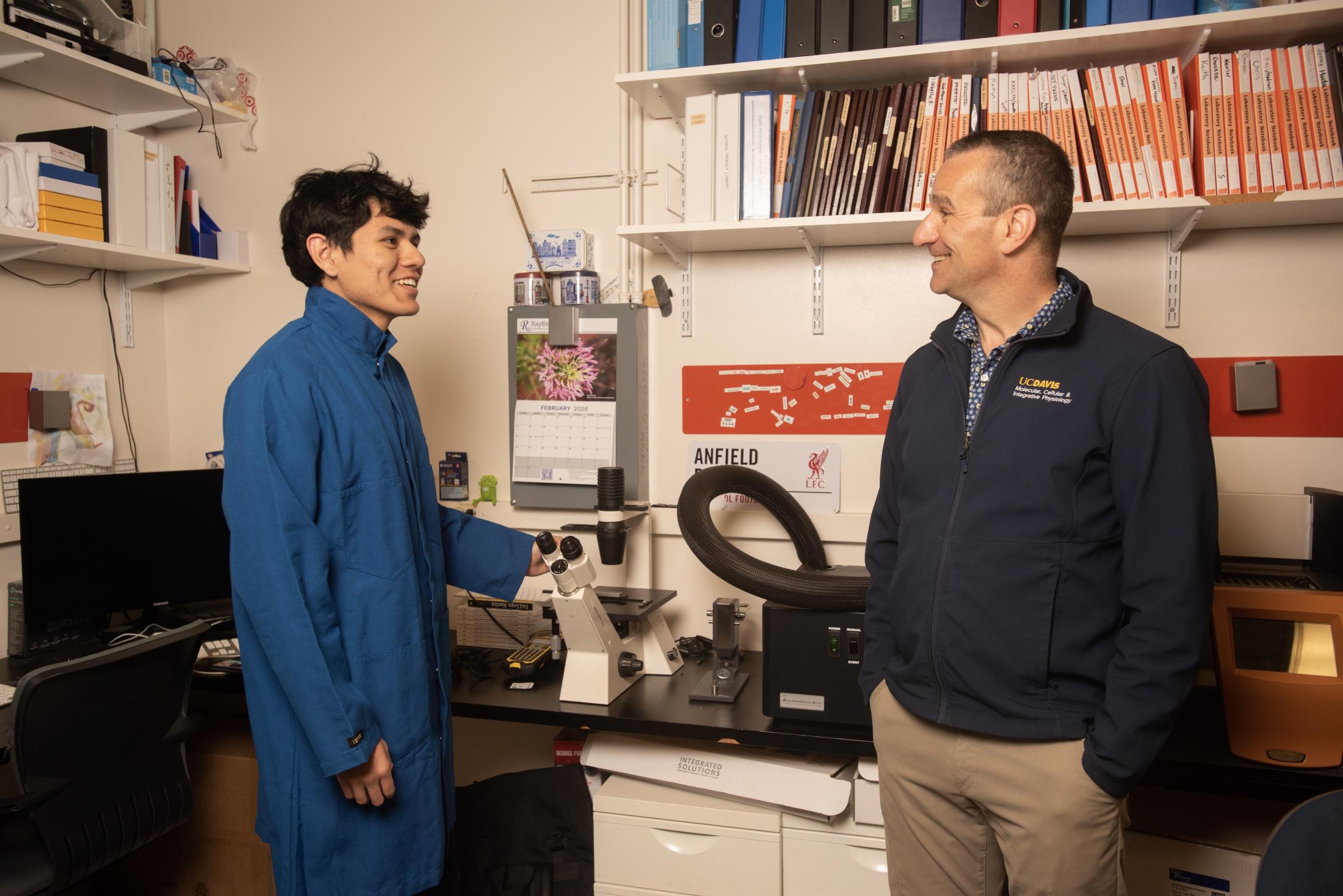
“Rogelio grew immensely as a scientist and a young man throughout his time in my laboratory,” Baar said. “He has gone from someone who just tries to learn scientific techniques to someone who asks interesting questions about human physiology.”
He also found mentorship and resources beyond the lab through UC Davis programs like the Advancing Diversity of Aging Researchers, or ADAR, previously hosted by the College of Biological Sciences. Castillo was connected to funding opportunities, research workshops and special seminars, which allowed him to focus and refine his own research.
Last year, Baar presented part of Castillo’s research, along with his own, to clinical leadership at UC Davis Medical Center.
“When Dr. Baar returned, he shared that one of the board members mentioned that they took Losartan,” Castillo said. They never thought about the potential impact of the medication on tendon health, until we suggested it.”
That experience solidified Castillo’s goal to pursue a career as a physician-scientist. He now prepares to take the MCAT and plans to apply to medical school, where he hopes to continue to improve patient-centered care with lab research.
Watch Rogelio's story on the UC Davis YouTube channel.