

There’s a joke by British TV comedian Benny Hill that Americans usually don’t get.
Hill is dressed up as an irate mother talking to the school headmaster who says her son is always absent and now he’s boozing. Hill insists that there are 40 pubs in town, and Johnny hasn't been in one of them. The headmaster says, “Oh, yes, which one's that?”
The humor comes from a very subtle ambiguity in what both sides mean by Johnny being in “not in one” pub. Hill means Johnny hasn’t been in any pubs, but the headmaster is implying that Johnny has more likely been in all of them.
But not all ambiguity in language is funny. In a court of law, the way ambiguity is interpreted can have repercussions measured in the billions of dollars.
“What frequently happens?” said John Hawkins, a Distinguished Professor of linguistics at UC Davis. “One side picks the one meaning and the other side picks the other. What you need is a linguist to come in and say, ‘Well, how does disambiguation normally work?’”
Hawkins is just such a linguist, and he has served as an expert witness in numerous high-profile court cases that hinge on disambiguation, which is the process of removing the multiple meanings contained in a passage of text.
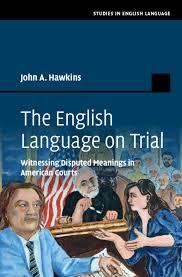
His new book, The English Language on Trial (Cambridge University Press, 2026), untangles some of the fundamental linguistic issues underpinning cases involving high-profile clients including Hollywood celebrities, major league sports teams and some of the world’s largest corporations. Each of them came down to some of the built-in ambiguities or other subtleties in the English language itself.
“People wouldn't normally disagree on these things if it was outside the courtroom, and these are systematic and there's many of them,” said Hawkins. “I've written many reports over the years that have tried to explain to lawyers and to the courts what the linguistic issue is, and what the proper judgment should be.”
Ambiguity in the English Language
The English language has many more ambiguities than many other languages, said Hawkins, and for specific reasons. One is that over the past millennium, English has undergone incredible simplification in its word forms compared to its predecessor language Old English. These changes were driven by contact between the English and populations from Denmark and other Vikings, as well as by the 1066 conquest by the French-speaking Normans.
“English has been exposed to a battering from languages and contact over its history, more than other similar languages have,” said Hawkins.
Ambiguity is rampant in English partly because so many of its verbs are used in ways they are not in other languages. For example, in English, you can break both a leg and a tennis racket string, but other languages use different words depending on what’s broken. Spanish has both romper, used in the general sense for causing damage, and quebrar, used for brittle things that shatter or for bankruptcy.
Another source of ambiguity are words with multiple meanings. Port is a type of wine as well as a place to dock a boat or to plug in a phone charger. Knowing the context of the sentence eliminates the alternative meanings.
In court cases, the word “substantial” comes up often, and it’s a word that almost could not be more ambiguous. The sun is substantially larger than the Earth, which compares the size of both celestial bodies, but your homework can also be substantially finished when most, but not all of it, is.
But what if a legal contract states that a billboard must be "substantially below" the top of a building’s roof? Does all of it have to be below? How far below? Here, the context must make clear what was intended.
Taking ambiguity in the English language to court
In total, Hawkins has served as an expert witness in over 50 cases. In his book, he details what many of the fundamental linguistic issues are and what the proper judgment should be.
In some of the cases Hawkins has worked on, he had to look closely at the broader context around the language under dispute. What other bits of language are relevant? How will average readers understand it? Sometimes that context involves how a word is used across society.
In a case involving the company Salesforce, Hawkins conducted an extensive analysis over the spelling of the company name that would be used to determine whether it could be used as the company trademark.
“When you have a trademark, you have to protect it,” said Hawkins.
Sometimes companies don’t succeed. Xerox and aspirin are two examples of “genericide,” in which a brand name becomes generic through common use.
At issue in the Salesforce case was how different is that one-word spelling from the general use of “sales force” as two separate words to describe personnel at any company who are responsible for sales.
Hawkins conducted a comprehensive database search to find out. He counted the instances in which the one-word version identified either the company or a corporate sales team and vice versa. He found that overwhelmingly the single-word version, “Salesforce,” was used in the context of the company itself.
Hawkins was also an expert witness in Apple’s 2013 trademark dispute against Amazon over the use of the name “App Store.” Apple claimed trademark for the name, arguing it had been the first to use it.
One of the lawyers Apple hired was Robert Leonard, a well-regarded linguist, who came to one of Hawkins’ depositions and supplied questions to Apple’s legal team. Leonard leads the Forensic Linguistics Justice Project at Hofstra University that reanalyzes cases in which language evidence played a crucial role in the defendant's conviction and sentence of death.
In the end, Hawkins’ analysis showed that “app store” truly was used generically. Even Apple CEO Tim Cook had used the term generically in an earnings call. In the U.S., Apple went on to withdraw its claim before trial.
“If you've got a phone from a manufacturer other than Apple and you have an ‘app store,’ it’s because of me,” said Hawkins.