
Agrivoltaics: One Acre, Three Jobs
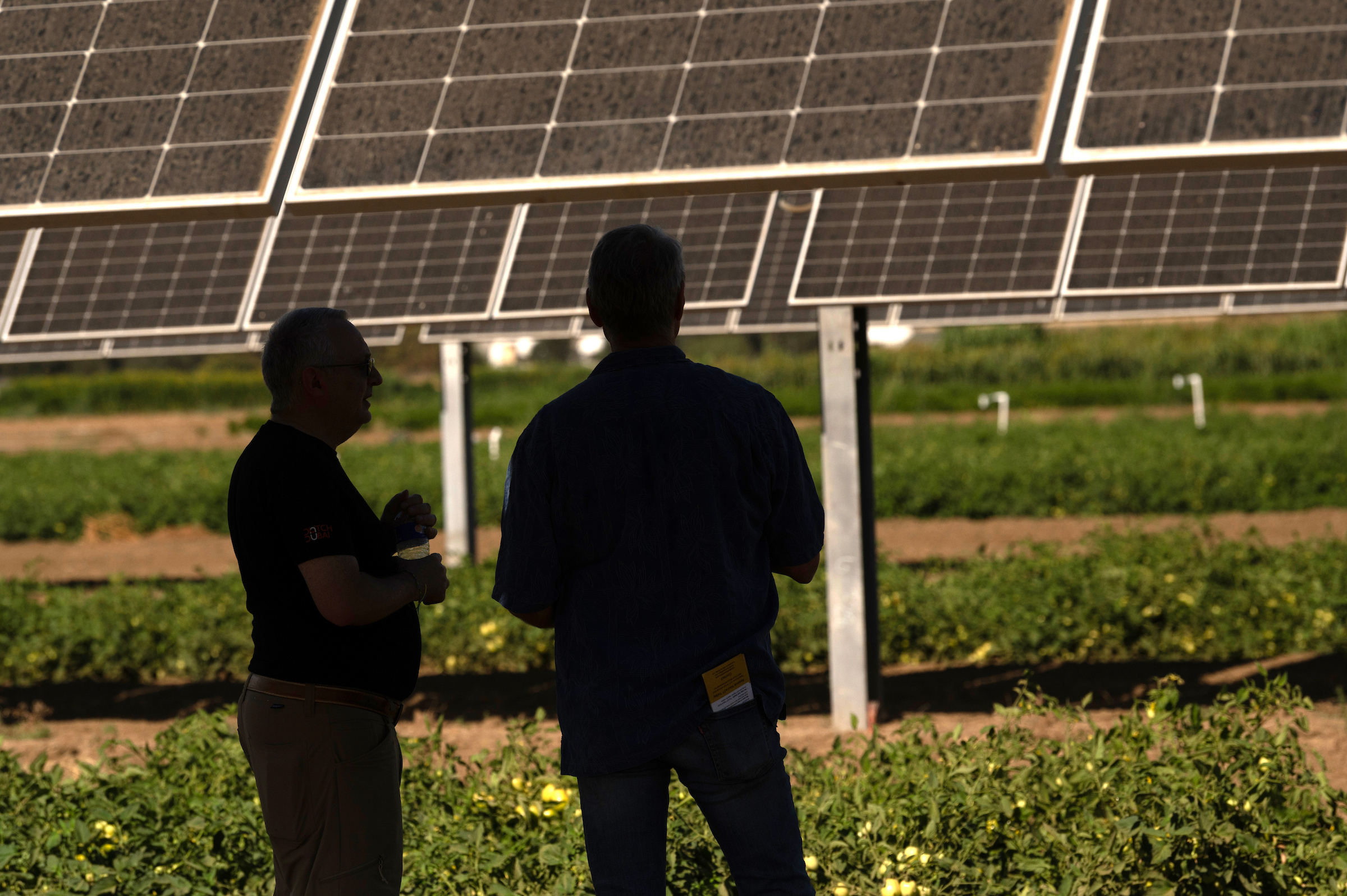
Solar panels and tomatoes may not seem like an obvious pair. At UC Davis though, they share the same field. Agrivoltaics is the practice of using solar panels in farm fields, creating energy while growing crops. Researchers say the solar panels have another job: saving farmers water by shielding crops from extreme heat. In this episode of Unfold, we step into a tomato field turned climate experiment to see what growers and scientists are weighing as the planet warms.
In this episode:
- Majdi Abou Najm, UC Davis professor of soil biophysics
- Gavin Chaboya, UC Davis Ph.D. student in Abou Najm’s lab
- Kevin Logue, business development director at Sunlight Energy
- Greg Roth, walnut farmer in Winters, Calif.
- Bruce Rominger, farmer in Yolo County, Calif.
Read an in-depth In Focus feature story on agrivoltaics.
Transcript
Transcibed using AI, may contain errors.
Amy Quinton
Guess what? Unfold has won two national Signal Awards for our episode about Valley Fever called Just One Spore. That puts the show in the company of productions from CNN, Amy Poehler, NPR, and some of the best audio storytellers in the business. You can listen to the episode on your device or on our web page at ucdavis.edu/unfold. Listen and then subscribe to Unfold so you never miss an episode.
Amy Quinton
Okay, Kat. Picture this.
Kat Kerlin
All right.
Amy Quinton
It's just past sunrise in the summertime.
Kat Kerlin
Okay. Where am I?
Amy Quinton
In California's Central Valley and an agricultural research field just on the edge of campus here at UC Davis.
Kat Kerlin
Okay, I'm picturing it. If it's summertime, I imagine it's warm.
Amy Quinton
Yeah, but it already feels less like warmth and more like a weight, you know?
Kat Kerlin
Yeah, like heavy, like an oppressive physical weight.
Amy Quinton
I want you to not just picture it, but feel it.
Kat Kerlin
I've felt that before, and it is so hot. It's like the sun has teeth.
Amy Quinton
Right? And you're standing in these rows of tomato plants, right? And the heat is radiating off the soil,
Kat Kerlin
wicking away any moisture on the plants.
Amy Quinton
Right! It's an almost hostile environment. It's the kind of heat that can scald a tomato right on the vine.
Kat Kerlin
Those tomatoes are in a battle with the sun.
Amy Quinton
Exactly. So standing in the middle of this blistering tomato crop with you, feeling that exact same heat, is UC Davis professor Majdi Abu Najm. He's a professor of soil biophysics in the Department of Land, Air, and Water Resources.
Amy Quinton
And he's looking out into these fields, and he says something so simple, but really captures a big problem in California. You know, a state that quite literally feeds the nation.
Majdi Abou Najm
If you live in the Central Valley, you realize two things: we don't have a lot of water, and we have a lot of sun. It can get to a place where the sun can become stressful to the crops, damaging if it is too much, it can cause catastrophic or near catastrophic failure.
Amy Quinton
You wouldn't think the sun would be so damaging, right? Tomatoes need sun to grow, but they also need moisture.
Kat Kerlin
But in a changing warming climate, California is getting hotter and it's getting drier,
Amy Quinton
Right.The sun is becoming a liability, Majdi has spent years thinking about that intense sun, but he doesn't see it as a threat. He sees it as a resource, a resource that nobody's fully cashing in on.
Majdi Abou Najm
Sun is needed, but too much of it is bad, and this is where agrivoltaics come to play.
Kat Kerlin
Agrivoltaics, say it with me now. Agrivoltaics. Okay, it's the practice of using solar panels in farm fields. It's growing crops and generating solar power on the same acre at the same time.
Amy Quinton
Those solar panels do more than generate energy; they also shield the plants from too much sun.
Majdi Abou Najm
When the plant gets less sun, it will be less thirsty. It will require less water. It will be less damaged from too much sun. So we worry less about heat-induced stress and heat-induced diseases and damages.
Kat Kerlin
So theoretically, every acre of land could become a lot more efficient with agrivoltaics, growing food, creating energy, and potentially saving water.
Amy Quinton
If we could connect this to the bigger picture, the stakes are much higher than just this one tomato field.
Kat Kerlin
We have a growing global population to feed, with a lot less usable farmland and in a far more hostile environment.
Amy Quinton
Right, which means every single acre of farmland left on this planet is going to have to operate with maximum efficiency.
Kat Kerlin
The urgency is clear, but is agrivoltaics the answer?
Amy Quinton
Can one acre grow food, save water, and make power all at once?
Kat Kerlin
And what are the trade-offs? That's what we're going to discuss in this episode of Unfold.
Amy Quinton
Coming to you from UC Davis, this is Unfold. I'm Amy Quinton, and I'm Kat Kerlin.
Majdi Abou Najm
All right. Good morning, everyone. Good to see you all. Thanks for coming, so what is agrivoltaics.
Amy Quinton
Majdi is giving a tour of an agrivoltaic site here on campus, right in that tomato field.
Kat Kerlin
The site is a testing ground for four different solar designs, starting with vertical solar panels.
Amy Quinton
And these vertical panels are placed along the rows of tomatoes, so they're perpendicular to the ground. Picture it? it looks like a dark glass fence lining the field.
Kat Kerlin
The panels have solar cells on both sides and shade different parts of the crop as the sun's light moves across the field.
Majdi Abou Najm
It's operationally much easier than any of the others because the tractor does not have to worry about passing under the panels. It's just passing in between them.
Amy Quinton
That makes harvesting much easier. And then there are two systems that tilt and track the sun east to west.
Amy Quinton
And finally, what I think is the most interesting one.
Majdi Abou Najm
The last one is facing south, and it's fixed. We call it fixed tilt, and it's red because we're testing a spectrally selective module system.
Kat Kerlin
To explain a bit further, the solar panels are a translucent red. Researchers found that the red part of the light spectrum is more efficient for growing plants, while the blue part of the spectrum is better for solar energy production.
Amy Quinton
So the solar panels allow the red light to pass through to the plants, while the blue is used for solar energy.
Majdi Abou Najm
We're not only optimizing light, but we're optimizing every single spectrum of it.
Amy Quinton
It's kind of like using red shade cloth in your garden. Yuba City-based Sunlight Energy worked with Majdi to engineer and build these solar systems.
Kat Kerlin
Business Development Director Kevin Loge says the agrivoltaic site allows growers to see what type of design might work best on their farms before committing to one.
Kevin Logue
it's still in its infancy, right? So people are still wanting to learn, and then people are afraid of being the first. So having a setup like this is huge.
Amy Quinton
So far, U.S. farmers have dedicated about 5,000 acres of land to grow food and create solar energy, according to a Department of Energy database.
Kat Kerlin
It's a small slice of available farmland, but agrivoltaics may be an important step as farmers face a hotter, drier future.
Amy Quinton
The agrivoltaics project is funded through the California Department of Food and Agriculture's Specialty Crop Block Grant program, which comes from the U.S. Department of Agriculture. Learn more about how public investment in UC Davis research powers innovation, strengthens the economy, and advances human health at ucdavis.edu/research/labs-to-lives.
Kat Kerlin
Back at the site, Majdi walks a group of visitors past buried irrigation lines.
Majdi Abou Najm
I spoke a lot about water. What we are testing is can we irrigate less in a system like this? And we have two setups in here. This entire section, those tomatoes, we're giving them half of what they need, so just 50%. The other section, we're giving them the 100%.
Kat Kerlin
He's highlighting another important aspect of the experiment, especially in California:
Kat Kerlin
Limited water. We are a drought-prone state.
Amy Quinton
Yeah, and I remember Kat when SGMA was signed into law in 2014, when California was experiencing its worst drought in history.
Kat Kerlin
Yeah, SGMA. That's the Sustainable Groundwater Management Act, the law requiring growers to pump less water out of aquifers.
Kat Kerlin
And research shows that law may force some farmers to fallow their fields.
Majdi Abou Najm
There will be probably 10s of 1000s, hundreds of 1000s, if not millions of acres that will go fallow. So this is not a land question. This is an overall productivity question. What our group is trying to solve is how much food can we generate with this fixed amount of water.
Kat Kerlin
Gavin Chaboya is a master's student in Majdi's lab. He's placed sensors in this tomato field to measure everything about how the plants respond to these solar panels.
Gavin Chaboya
We need to see how stressed the plants are. What are what are the problems directly caused by the deficit irrigation, and how do these specific vertical panels address those issues, or at least help combat them?
Amy Quinton
For example, he says you'd expect the row of tomatoes closest to the panels to have less yield.
Kat Kerlin
The ones that are in shade most of the day,
Amy Quinton
right? Gavin is trying to answer questions like, to what degree does that yield change, if it does at all? He's also looking at evapotranspiration. Kat, my favorite word to say, evapotranspiration.
Kat Kerlin
It's a good one. Well, that's how much water the tomato plants pull from the soil and release into the air,
Amy Quinton
Farmers and water regulators rely on a model to predict that, and it assumes these plants will get full sun.
Kat Kerlin
When a panel shades part of a field, that model no longer accurately estimates just how much water the plants need.
Gavin Chaboya
There is no model for agrivoltaics.
Amy Quinton
Gavin says agrivoltaics basically creates its own microclimate.
Kat Kerlin
What the researchers find could eventually help growers weigh whether agrivoltaics pencils out for them,
Kat Kerlin
and help them meet water conservation requirements in a changing climate.
Gavin Chaboya
Late July, early August is when we expect to see the highest heat. So seeing how the plants respond to that heat and the shade gradient, and how it either buffers that or protects other plants. This is what needs to exist in order to make previously unsuitable lands suitable for farming.
Amy Quinton
If agrivoltaics is this promising, why isn't every farm doing it?
Amy Quinton
Well, Majdi says it's not an easy decision, as you might imagine. It's not something like just deciding to throw compost on your field one year.
Majdi Abou Najm
There's a major capital investment in here. If you commit to agrivoltaics, you've transformed your field for the next 25 years, if not forever.
Kat Kerlin
Cost can vary depending on design, but 100 kilowatt system, like enough to power 10 to 15 homes for a year, that could easily run between $250,000 to $300,000 installed. Majdi says the financing world simply hasn't caught up.
Majdi Abou Najm
This has been a major challenge. You can go to a bank and get a loan probably for your rooftop solar, but I haven't heard of banks yet giving loans on agrivoltaic systems.
Amy Quinton
A number of growers came out to walk around the agrivoltaics demonstration site, and that included Greg Roth, a walnut farmer from Winters, California.
Kat Kerlin
His family also grows corn, wheat, soybeans, and sugar beets in Michigan, where they already have wind turbines.
Greg Roth
They want to add to the wind farm solar panels, but because it takes up so much land and it makes it really difficult to continue regular agriculture with tractors. But this vertical approach is very exciting because it keeps the rows clear. I think it's less damage to the to the land in terms of the pilings, and you know, so it could be turned back if it wasn't profitable.
Kat Kerlin
Greg says agrivoltaics could also give farmers more stability.
Greg Roth
Although you have a slight reduction in crops' yield, but still you can add back the energy generation. So that's really exciting to us, and it almost gives you more stable income when crop prices go up and down.
Kat Kerlin
He isn't sure yet how or if this would work with walnut trees, but some orchard crops like olives, grapes, apples, and pears benefit from the shade that panels would provide.
Kat Kerlin
And then there's Bruce Rominger, who grows a little of everything in Yolo County. He already has a small solar project that offsets the power for his irrigation pumps.
Bruce Rominger
But we're interested in a larger scale project where we can be selling power to a utility, but yet still have irrigated pasture underneath to graze sheep.
Kat Kerlin
Combining solar with livestock grazing is often called range voltaics, but he says he does have some concerns with the technology.
Bruce Rominger
It's evolving very rapidly, and that's that's one of the scary things about doing something like solar panels. Even I've learned in the project we've already done the small project. Knowing the price of solar panels today, I would have designed it differently, but they've gone down, down, down in price so much that the economics of the type of solar structure you do is different than it used to be.
Amy Quinton
Despite that uncertainty, he says he's not ruling anything out.
Kat Kerlin
For the last two years, Majdi grew peppers in this field instead of tomatoes,
Majdi Abou Najm
We harvested peppers last year, and the peppers were amazing. Peppers is much more efficient under shade than tomatoes, and we systematically got either the same yields or even in some places slightly higher.
Amy Quinton
He says those peppers that weren't under shade were damaged from too much sun.
Kat Kerlin
So, what's it going to take to speed this process up to get more farmers to adopt?
Amy Quinton
Majdi says, unfortunately, it all boils down to policy.
Majdi Abou Najm
It's just policy. Agrivoltaics in Europe was embraced and subsidized and helped. I can tell you the moment we embrace it in California and in the U.S. we will be able to scale this to ways that will be bigger and more effective.
Kat Kerlin
For Majdi, all of this, the cost, the missing science, the growers still weighing whether to jump in, comes back to a much bigger equation.
Majdi Abou Najm
We're living in a hotter and drier planet, and it's getting hotter and drier as we speak. Agrivoltaics is a way to make the hotter into energy generation, and as you do that, you'll create a microclimate that will make agriculture feasible even in a drier place.
Amy Quinton
Whether agrivoltaics works for growers will depend on what researchers learn about water yields, crops, and costs.
Kat Kerlin
Plus, a bank willing to write a loan.
Kat Kerlin
Still, it's a new way to look at the sun, not as an enemy or a weight,
Kat Kerlin
But as a way to grow food, save water, and make power.
Amy Quinton
All on one acre. You can find links to an in-depth story about agrivoltaics and UC Davis research at our website ucdavis.edu/unfold. I'm Amy Quinton,
Kat Kerlin
And I'm Kat Kerlin. Thanks for listening.
Andy Fell
Unfold is a production of UC Davis. Original music for Unfold comes from Damien Verrett and Curtis Jerome Haynes. Additional music comes from Blue Dot Sessions.