

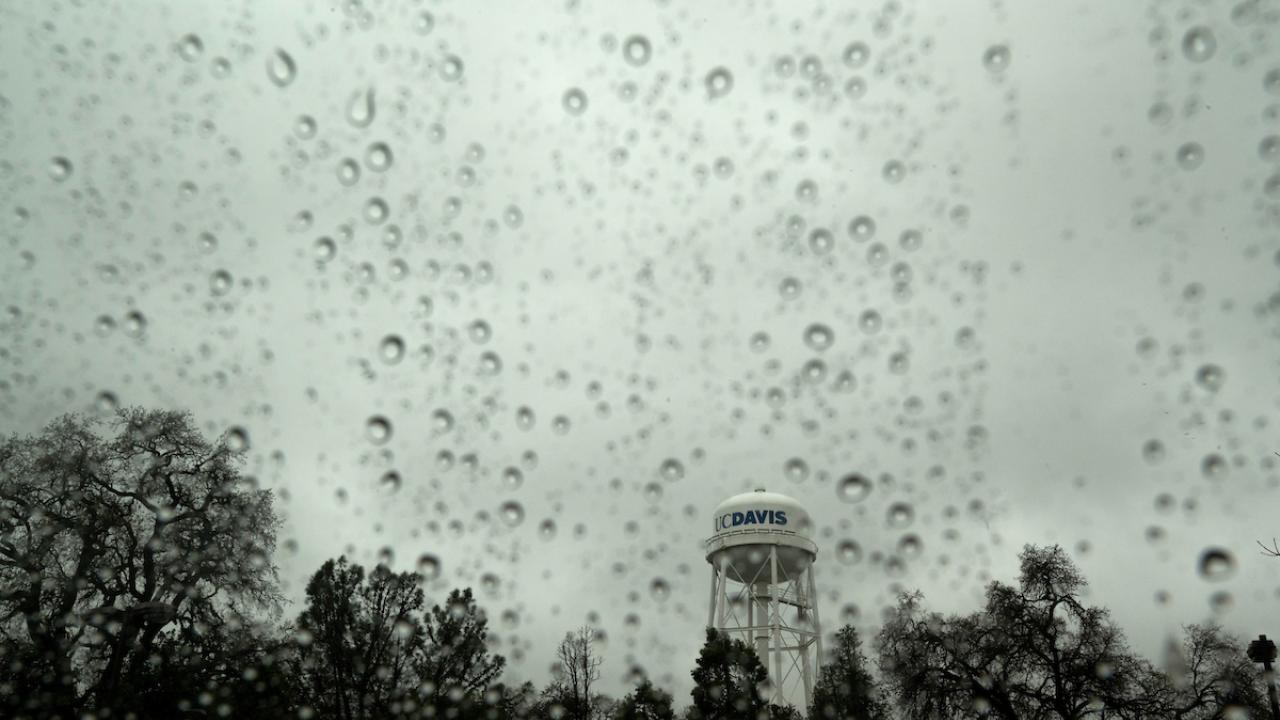
A “super El Niño” is predicted for this winter. What is El Niño, how might it impact local areas, and how does it relate to atmospheric rivers and climate change? The following UC Davis experts are available to discuss with reporters these and other related questions.
Flood risk and infrastructure
Nicholas Pinter, a professor in the Department of Earth and Planetary Sciences, is a nationally recognized expert in flooding, and flood risk and management. His research is focused on rivers, floodplains, flood hydrology and watersheds, which he’s applied to help provide a scientific basis for sound natural-hazards public policy at national and local levels. He can discuss how California can better secure its flood-risk future amid political and climate-driven storms. Contact: 530-754-1041, npinter@ucdavis.edu
Fraser Shilling, director of the Road Ecology Center within the Institute of Transportation Studies, can discuss how El Niño, sea level rise and powerful storms may impact California’s highways and coastal flooding risks. He can also discuss real-time monitoring approaches for flooding and resilience/adaptation strategies for coastal infrastructure. Contact: fmshilling@ucdavis.edu

Coastal and marine environments
Tessa Hill is a professor of oceanography at Bodega Marine Laboratory and the Department of Earth and Planetary Science. She can discuss how climate change, ocean acidification, and shifting marine conditions like El Niño events impact local California environments and coastal communities, including impacts on seagrass meadows, salt marshes, and oyster farms. Contact: tmhill@ucdavis.edu
John Largier, is a professor of oceanography and an expert in how the runoff of freshwater from the land enters the ocean, impacting estuaries, shorelines and the ocean. His research, centered in California, focuses on Mediterranean climates. Atmospheric rivers are more frequent in El Niño years, resulting in high flows and coastal flooding. The Coastal Oceanography Group at UC Davis has been studying high flows in the Russian River estuary, Tomales Bay and San Francisco Bay. Contact: jlargier@ucdavis.edu
Michael Springborn is an environmental and resource economist and professor in the department of Environmental Science and Policy. He is working to model current and future El Niño events in kelp systems. Contact: mspringborn@ucdavis.edu
Maike Sonnewald leads the Computational Climate and Ocean Group at UC Davis in the Department of Computer Science. She can discuss climate modeling related to the ocean, including El Niños, sea level rise, marine protected areas and other areas. Her research blends computational, machine leaning and Earth science tools to improve forecasting and to learn more about the ocean’s role in the climate system. Contact: sonnewald@ucdavis.edu
Atmospheric science, weather and climate change
Ian Faloona, a micrometeorologist in the Department of Land, Air and Water Resources, can discuss the physics of our changing climate in California, including the state of El Niño/La Niña currently and how it is developing, and what factors in the climate system are changing most acutely and how that will affect our local climate in California. Contact: icfaloona@ucdavis.edu
Matthew Igel, is an atmospheric scientist who leads the Convective Atmosphere Group at UC Davis. His research focuses on understanding the properties and behavior of clouds and precipitation. He can discuss weather forecasts and weather occurring in California and across the country. Contact: 530-752-6280, migel@ucdavis.edu
Paul Ullrich, a professor in the Department of Land, Air and Water Resources, specializes in regional climate modeling and can comment on climate change’s influence on extreme weather events and atmospheric dynamics. Listen to him discuss El Niños on Capital Public Radio’s Insight in November 2023 (begins minute 18:00). Contact: 530-400-9817, paullrich@ucdavis.edu
Media Resources
Media Contact:
- Kat Kerlin, UC Davis News and Media Relations, 530-750-9195, kekerlin@ucdavis.edu